80. The Siege of Massilia Part II and the Mutiny of the Ninth
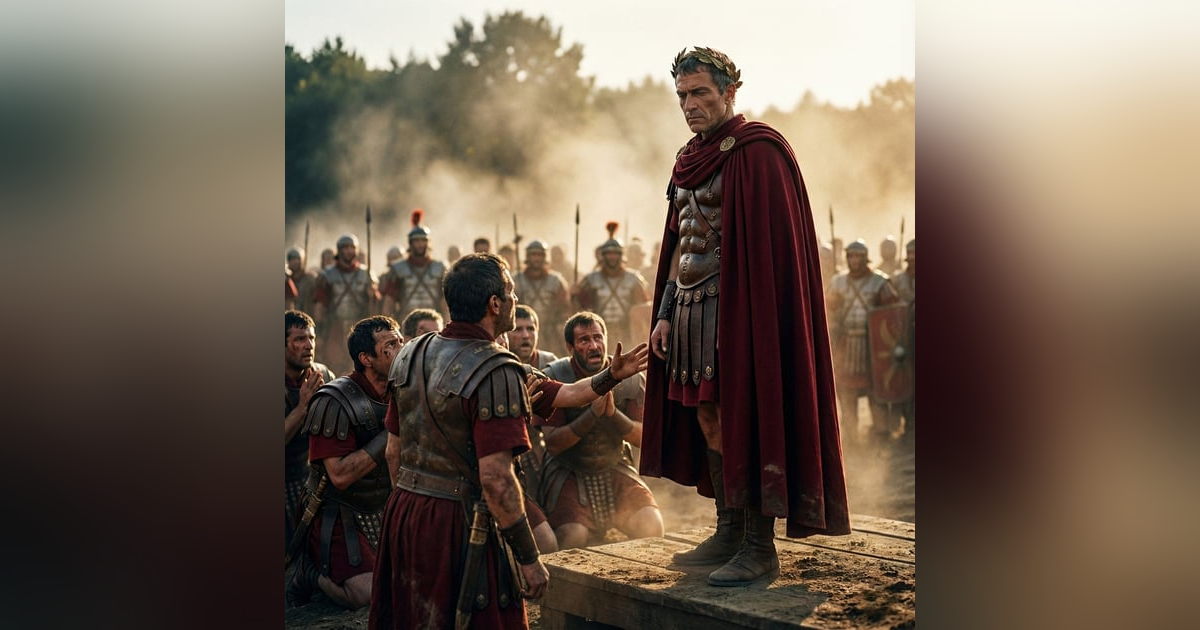


The Siege of Massilia reaches its dramatic climax as Caesar’s legions build new and innovative siegeworks to overcome the defiant Massiliotes. At last, Julius Caesar arrives on the scene and quickly gets hit with a flurry of news items. In his absence, Rome has appointed Caesar as Dictator. On a more ominous note, the veteran Ninth Legion has instigated a mutiny among Caesar’s army in Placentia. Always one for decisive and bold action, Caesar races to the scene to face down the mutineers.
Amazon
Support The March of History by making your Amazon purchases via this free link at no extra charge to you.
Disclosure: As an Amazon Associate I earn from qualifying purchases at no extra charge to you.
Website
Venmo
If you enjoyed the episode and want to leave a tip, click the link below!
https://venmo.com/code?user_id=3764325529420842984&created=1680471101.0362968&printed=1
Patreon
If you want to contribute to The March of History with a monthly donation, click the link below!
https://www.patreon.com/themarchofhistory
PayPal
If you want to contribute to The March of History with a one-time or monthly donation, click the link below!
https://www.paypal.com/donate/?hosted_button_id=QZREW4PVL2M3A
Youtube
https://www.youtube.com/@themarchofhistory
Social Medias (All can be found at the following link):
linktr.ee/themarchofhistory- Instagram - @themarchofhistory
- TikTok - @themarchofhistorypodcast
- Twitter - @march_history
- Facebook - Search "The March of History"
Music: LucasNapoleone/Shutterstock.com
----more----
Show Summary:
The March of History is a biographical history podcast on Julius Caesar and the fall of the Roman Republic. Not only does it cover Julius Caesar's life in depth, it also explores the intricate world of ancient Rome and all of the key players of the late Roman Republic including Cicero, Pompey, Crassus, Cato, Clodius, Mark Antony, Brutus, a young Augustus (Octavius), Marius, Sulla and (though not Roman) Cleopatra.
The Massiliotes had filed this up the next day with an attack on the other siege ramp near the harbor, but the Romans had managed to fend this off and preserve these siege works. And though no source mentions it, the Roman soldiers must have been livid with Trebonius. They were already angry with him when he had prevented them from storming the city and massacring the inhabitants. Now it seemed that they were right and he was wrong to trust the Massiliotes.
Caesar, however, says that the Roman soldiers' determination was greatly increased by these events. He writes,
“They saw that their immense efforts and preparations had come to nothing and were bitter that a mockery had been made of their courage by the criminal violation of the truce…”.
Or in the words of Napoleon, or rather to paraphrase him, the burning of the siege works outraged the Romans without discouraging them. It was sort of the worst of all worlds for the Massiliotes.
And so, with this frustration fueling their determination, the legionaries embark on a whole new building spree. And I don't just call it new because it will be built to replace the old, now burnt down siege works. I call it new because these siege works the Romans are about to build, according to Caesar, are unprecedented for a Roman army. Once again, the clever determination of the Massiliotes is forcing the Romans to innovate. And this innovation is a necessity.
You see, Caesar writes that all of the trees in the territory around Massilia had been cut down in order to build all of the previous siege equipment, which gives us an inkling of just how ravenous a Roman army is. Granted, we are talking about the territory around a city-state, so no doubt Massilia had been depleting these forests for centuries already, but still, what was still there is now gone from Caesar's army's consumption of it.
Regardless, the legionaries do not have enough lumber to rebuild their ramp in the same way I explained in last episode. Fortunately for them, they have learned over the course of this siege how useful sun-dried bricks can be. And so they embark on building what Caesar describes as a new and unprecedented ramp, using a combination of what wood they can find and these sun-dried bricks.
They start by building two brick walls, each six feet thick. They then bridge these brick walls with what timber they can find to form a sort of roof. These two brick walls being bridged by timber will become the new ramp, with the wood bridging them acting as a sort of boardwalk. Caesar tells us that it was as wide as the original ramp, and we think the original ramp was around 60 feet wide.
Now it might strike you that 60 feet is quite a distance to bridge without supports, and you'd be correct. Caesar tells us that when either the distance between the two brick walls, or the weakness of the timber used dictated, the Romans drove piles into the ground between the walls as support pillars, and laid cross beams on these pillars to help support the wood bridging the two brick walls. The brick walls are then built forward toward Massilia, and they grow taller as the valley between Trebonius' camp and Massilia deepens. And as the brick wall extends, the Romans continue to bridge them with wood and erect pillars to support this wood when needed.
Now, over top of this wood that bridges the two brick walls, the boardwalk, the Romans lay down wicker, which they have plastered with clay. And this whole structure has the added benefit of forming a protective tunnel for the legionaries to bring up new material through. They are protected from attacks on the left and right by the two brick walls, and they are protected from ballistae bolts from above by the wood bridging the two brick walls, now covered with wicker and clay too. When the soldiers move out in front of this structure, the Romans have a shed to protect them from enemy missiles.
Meanwhile, the Romans periodically build doorways in the brick walls to allow them to sally out and chase off any Massiliotes or Albici who might try to destroy this new innovative ramp. This means this ramp is part siege ramp and part fortress, because it has these doorways where the men can come out to attack the Massiliotes or to attack the Albici or retreat within these brick walls if needed.
Now, the Massiliotes are watching this construction project from their city walls, and they had to have been triumphant when they burned down so many of the Roman siege works. But now, they start to feel nervous. This is not what they counted on. They thought the Romans would be irrevocably set back. Now they see the Romans building this brick ramp fortress, the likes of which they've never seen before, and it's getting closer and closer to their city. It's as if the Romans are building an elevated highway that aims to go straight through their city wall.
Now, Caesar writes that the Romans rebuilt all of this in only a few days. That seems a little hard to believe considering it had taken them months to build the original siege works. But maybe this new innovative method was much more efficient. Maybe these soldiers and conscripted laborers had gotten better at their jobs. And then, of course, last time around, Trebonius had to go around the area pressing men into service. This time he already has his labor force ready to go.
Even still, all of this reconstruction in only a few days does seem hard to believe. But regardless of how long it takes, the Massiliotes start getting very nervous. It seems to them unlikely they will be able to set this new ramp on fire. They were only able to set the last one on fire because the Romans had let their guard down during a truce. This isn't going to happen twice. What's more, this new ramp's walls are made of brick…and sure, you could burn the wood bridging the brick walls, if you could get inside the brick walls and underneath the wood… but the Romans have built this thing like a fortress… they have gates to sally from, and there are men between those brick walls at all times.
And this whole ramp is getting closer and closer to their city until it is nearly on top of them. Caesar writes on this,
“…our army seemed to have built its walls practically on the walls of the town, and we were near enough to throw missiles.”
All of this makes the Massiliotes realize, according to Caesar at least, that the Romans can build walls and towers right on top of their city wall. I mean, at this point, they've witnessed the Romans build that six-story brick tower right next to their wall. And now they're witnessing them build this new ramp, which consists of two large brick walls.
So if they can do this, then they can conceivably build a wall complete with towers right next to and, I guess, parallel to their city wall. And Caesar tells us, the Massiliotes realize that if the Romans do this, the Massiliotes won't even be able to hold their ground on their own walls. The Romans would be able to drive them from their walls as they had done with the brick tower. Caesar tells us that they were well aware that once it comes to equal fighting from walls and towers, the Massiliotes would be no match for the Romans in strength and courage.
On top of all this, now that the Romans are so close, Caesar tells us that the giant Massilio ballistae aren't much use. Being mounted on the city wall, they can't aim downward enough to hit people and siege works so close to the city. The Massiliotes put much of their faith in these ballistae, so this is alarming to them. That is, according to Caesar at least, though certainly the Romans had been that close and closer before, before the burning of the siege equipment. After all, they had wheeled a siege tower and battering ram right up to the city wall, and they had brought the musculus right up to the base of one of the towers, so it's not as if this is a new development.
But stress and fear can be additive. Perhaps by this time the Massiliotes' nerves are frayed, or they're just realizing that the Romans will just never give up, they're not going to stop. And there are other variables to consider too. The Massiliotes have been blockaded by land and sea for months now. Caesar tells us that by this point they were living off of old millet and rotting barley. This is food they had long ago gathered and stored for public use if ever put under siege. But I guess it sat too long though, and right when they needed this food the most, they find it rotting. Starvation will certainly sap your will to fight and overcome obstacles. Another consequence of this starvation is disease. When people starve, their bodies weaken, including their immune systems, and diseases can then run rampant. Caesar tells us by this point the Massiliotes are ravaged by disease as a result of their poor diet.
In summation, Caesar writes the Massiliotes were exhausted by all their sufferings. Their food was running critically low, twice they had been defeated by sea, numerous sallies had been unsuccessful, their one tower had crumbled, long stretches of their wall had been seriously weakened. It's unclear what he's referring to here. Historian T. Rice Holmes speculates that either the other siege tower may have made it up the smaller of the two ramps and caused considerable damage to their city wall, or perhaps they completed the brick ramp and wheeled a siege tower up that ramp to damage the wall. Either one of these are possibilities. If so, Caesar left this out of the story completely. He does say that long stretches of their wall had been seriously weakened, though.
The final variable giving the Massiliotes hope is that help could arrive from outside, that Caesar could lose the war in Spain and Afranius or Petreius could come to their aid and lift the siege. Then word comes of Caesar's complete and total victory in Spain, and with that, there is just no hope of victory left. Their only hope is to be spared rape and ruin. And so, with this hope in mind, at the end of the summer of 49 BC, the Massiliotes offer to surrender to the Romans again and request they be offered the same terms as last time. They're hoping to get ahead of any sacking of their city, they want to avoid becoming another Corinth or Avaricum, and Trebonius accepts their surrender, although he insists on an alteration to the terms.
Yes, they can wait for Caesar, but in the meantime, they need to bring their weapons and artillery out of the city and hand them over. They have to take their ships and ship-sheds out of port, and finally, they have to give over their entire treasury to Trebonius, not to put in his pocket personally, but to be used for Caesar's war fund.
Now, it is a little surprising that Trebonius gave the Massiliotes such lenient treatment after they had betrayed the previous truce. In fact, it's a little surprising he had allowed them to surrender so easily in the first place, the first time around. Historian Adrian Goldsworthy writes in his book, “The Complete Roman Army”, that the Romans had a law that if a besieged city surrendered before the ram touched the wall, that being the key moment, they could expect favorable terms from the Romans.
But once the ram did touch the wall, mercy became a highly unlikely prospect. You cannot fight a siege in its entirety, and then right when you're about to lose said siege and be sacked, say, “Oh, never mind! We surrender!”, and then expect to get the same generous terms you'd have gotten had you not spent months resisting the attacker. In the case of the first accepted surrender, though, the Massiliotes were very lucky and benefited from the fact that they were fighting against the clement Julius Caesar, and that their ancient city had such a high reputation with the Romans for being longstanding allies of theirs.
As for when or if the ram touched the wall of Massilia, at no point in our story do we have any source explicitly stating this. The closest we get is Vitruvius' story, where the Romans brought the ram up to the wall just to have the Massiliotes throw down a noose around it and crank it out of position. But Caesar does mention that by the end, long stretches of their wall had been seriously weakened. So, it may be that one of the rams did get some shots in on the wall, as I said earlier. Maybe the ram on the smaller of the two ramps, or maybe even this new brick ramp.
Anyway, it is even more surprising that Trebonius would accept their surrender a second time, though if you examine it from Trebonius' point of view, it does make sense. What are his goals? One is to win the siege as soon as possible so that Caesar can move on to fight Pompey in the east, and two is to spare Massilia from being sacked, as Caesar ordered. Accepting their surrender accomplishes both goals, and this time the Massiliotes have turned over their weapons and Trebonius can keep his soldiers on their guard for any mischiefs that a second burning of the siege equipment does not happen.
Now, it should also be said that Trebonius showing so much leniency could give credence to part of Cassius Dio's telling of this story. Remember, Dio had claimed that some Roman soldiers broke the truce first and attacked the Massiliotes at night, and if that is true, and the Massiliotes burn the Roman siege equipment in retaliation for this initial breach, that could explain why Trebonius was willing to accept their terms a second time.
Now, a few days before this surrender, Ahenobarbus gets a win that this is the Massiliotes' plan. Remember, he's in Massilia, and Ahenobarbus is, just to remind you, an arch-optimist, he's Cato's brother-in-law, and he truly loathes Julius Caesar. And Ahenobarbus has absolutely no desire, none, zero, to suffer the mortification of having to accept Caesar's clemency a second time. Nor can he be sure such clemency will be offered a second time. Clemency for political enemies in a Roman civil war is a strange beast to begin with. It's an odd thing. So from Ahenobarbus' perspective, it's very hard to know if it will be offered a second time. I mean, really, it's surprising it was offered a first time.
So before the Massiliotes have the chance to surrender, Ahenobarbus readies three ships in their harbor. Two of the ships he puts under the command of his friends. The third ship he takes command of himself. And around this time, a storm sweeps in with some nasty weather. Rather than putting Ahenobarbus off from trying to make his escape, it encourages him. His hope is that he will be better able to lose the forces of Decimus Brutus in the storm. So Ahenobarbus and his three ships set out for Massilia's harbor in the midst of the storm. Meanwhile, Decimus Brutus has his fleet of ships anchored off the coast of Massilia, keeping a blockade. And some of these ships spot Ahenobarbus, pull up anchor, and give chase.
These ships Ahenobarbus' friends are in command of, become frightened by this, and turn back, returning to the port of Massilia. Ahenobarbus presses on, though, with great effort, and with the aid of the storm, he is able to escape from the Caesarean ships, from the ships of Decimus Brutus. Having made two stands against Caesar that have both ended in failure, Ahenobarbus is not ready to give up yet. He sails his ship to join Pompey and his growing army in the region of Macedonia and Greece. And perhaps already there and waiting for him are Afranius and Petreius. The Pompeians have officially been chased out of the West.
Now we move our narrative back to Julius Caesar, our protagonist. We left him in episode 76, having completed his campaign in Spain and taken both provinces for himself. I then told you of how Caesar traveled to Massilia. There is one thing I left out about that journey, though, that I will mention now. On the road to Massilia, Caesar passes over the Pyrenees Mountains, between modern Spain and France.
Now once upon a time, a young Pompey Magnus had also crossed the Pyrenees, and while doing so, he had decided to ascend to one of the mountain summits and there infamously erected what the ancient sources describe as trophies to himself. These trophies, according to Pliny the Elder, boasted that he had subjugated 876 towns between the Alps and the borders of further Spain. Cassius Dio tells us that Pompey had gained no great name for himself by setting up these braggadocious trophies, meaning people didn't think very highly of him for it.
And Cassius Dio tells us Julius Caesar knew this, so when Caesar passes over the Pyrenees, he makes a point not to erect any trophies to himself, and instead erects a great altar constructed of polished stones. So it seems to be a religious altar which people would be more approving of, and he sets this altar up not far from Pompey's trophies. Even in the high reaches of the Pyrenees, the propaganda war rages on.
Well, Julius Caesar continues through the Pyrenees and, after stopping at the city of Narbo on the Mediterranean coast of modern France, he finally reaches Massilia sometime probably around the end of October 49 BC. Which means that the siege of Massilia ended, and then both sides just sat there and waited at least a month for Julius Caesar to show up. Well, Caesar does indeed finally show up, and when he does, he sees that Massilia had finally, well and truly, surrendered, handed over their weapons, ships, and treasury. And so he decides to show them some of that famous Julius Caesar clemency.
Echoing Sulla, he writes in the commentaries that he “spared them, more in accordance with the fame and antiquity of their state than with what they deserved of himself.”. Sulla, meanwhile, had famously said to Athens that he, spared the “living for the sake of the dead.”. In either case, the point being made is that the current inhabitants of these cities are not worthy of such respect, not worthy of such clemency, but their famous ancestors were. And so for the sake of these famous ancestors, the people of the present will be spared. Of course, in Caesar's case, Massilia is completely spared, no sack at all. In the case of Sulla, he did brutally sack Athens, but Sulla's point was that he could have done so much worse. He could have annihilated the city. So big surprise that the clemency of Julius Caesar and that of Sulla look quite different.
And just like that, finally, the epic siege of Massilia is over. Massilia was lost in the end, despite all of their ingenuity and determination. But they did manage to dodge their greatest fear, a complete sack and extermination or eradication of their city. All of the men killed, the women and children sold into slavery, the city itself plundered and burned. They managed to avoid all this.
However, Massilia's days of political independence are over. Having sided against Caesar in a civil war, having first deceived him in claiming to be neutral, having then wasted his army's time and resources for months, and finally having deceived Trebonius with a false truce, Massilia must be punished in some fashion. So Caesar strips Massilia of a large part of its surrounding territory, which is equivalent to stripping it of a large part of its wealth and power. Although he does allow the city, at least nominally, to keep its autonomy. Caesar then orders two legions to stay behind and garrison the city. So like I said, nominal autonomy, it's not real autonomy. And in a strike back in the propaganda war, Pompey awards Massilia's mother city of Phocea in the East their freedom. This is Pompey's way of rewarding the Massiliotes for their valiant stand on his behalf and his attempt to make up for their loss of their own freedom, and maybe a way of apologizing for the fact that he left them hanging.
Now, around this time, Caesar starts getting floods of important news. As he's returning from Spain, he receives news of Curio's death and defeat in Africa, along with the defeat and capture of Gaius Antonius in Illyricum, and Dolabella's naval defeat. In sum total, this means he has lost three and a half legions, at least 500 cavalry, and a naval fleet. And remember, Gaius Antonius' legions were mostly impressed into the Pompeian army, so that's double damage. You lost legions, and Pompey gained legions.
So though the news from Massilia is great, it is offset by all these other disasters. Though, at least none of the legions lost were veterans of the Gallic Wars. Those are all safe. And Caesar is resilient, none of that banging his head against doors and repeatedly shouting, “Gaius Scribonius Curio, give me back my legions!” None of that for him. Caesar continues to press onward!
And if you don't know what I'm talking about, many years later, when Augustus is emperor, one of his subordinates will lose three legions, along with six cohorts of auxiliaries and three cavalry a la in an ambush in Germania. Augustus is then so bent out of shape by this, that he repeatedly bangs his head on doors and shouts, “Quinctilius Varus, give me back my legions!” And with that one defeat, the Roman conquest of Germania was called off. Effectively called off.
And I've never understood it, and it always gives Augustus the appearance of having such a brittle spirit when it comes to military matters. Granted, no one wants to lose legions in the lives of their soldiers. But when the unthinkable does happen, Julius Caesar picks himself back up, dusts himself off and keeps on winning. Augustus bangs his head against doors. Though I will say in defense of Augustus, he was almost 71 years old by the time of that story. But it still blows my mind that the entire Roman conquest of Germania was called off due to the sort of loss that we see Julius Caesar here eat like it's nothing. Doesn't slow him down a bit.
Anyway, the next crucial items of news Caesar receives while at Massilia consist of both good news and bad news. We'll talk about the good news first. At least good news from Caesar's perspective. Caesar writes in the Civil War commentaries that when he arrived at Massilia, he learned that a law had been passed to name a dictator at Rome and that he had been named dictator by the praetor Marcus Lepidus. The way Caesar writes about this is as if this was some complete surprise to him. You get the impression that he was surprised to hear a law had been passed to name a dictator and even more surprised to learn that he was the one named.
But of course, such a thing is highly unlikely to have happened without his orchestration. Though I suppose it is possible that Lepidus did it without asking as a way of getting in Caesar's good graces and at the same time allowing Caesar to plausibly claim that he did not seek the dictatorship. In the commentaries, though, Caesar doesn't make any such denial. He simply gives his version of the facts in a single sentence.
Now, given what happened the last time Rome had a dictator in Sulla, Rome is likely more than a bit worried that Caesar is reviving this particular office. However, in his defense, Caesar seemed to have done almost everything he could to avoid becoming dictator at this stage. You see, at this point in the Civil War, making himself dictator doesn't exactly look good in the propaganda war. Now, it's not as if Caesar has no interest in the dictatorship, it's more that it's not the right time for the dictatorship. Instead, what Caesar really wants is to be consul. Remember, this was a huge part of what led to the Rubicon Crossing.
Caesar wanted to be able to run for another consulship in absentia so that he could go straight from his current pro-consulship to a consulship and thus never lose immunity from prosecution. He would then use the consulship to gain for himself a new super pro-consulship, we'll call it, the kind that lasts for five years and consists of multiple provinces. That would then allow him to go straight from the consulship to this new pro-consulship and again, without ever losing immunity from prosecution. He will also have waited the required ten years between consulships, something Pompey didn't bother with on his third consulship.
Of course, in the end, it all went up in smoke, as we saw in episodes 67 and 68, and Caesar crossed the Rubicon. But make no mistake, he still wants that consulship. At this point, though, fear of prosecution is not the main motivation. Things have moved beyond the law courts and there is an open civil war. Yes, the consulship could still come in handy for its immunity and power if he does find a way to work out a peace deal with Pompey. In such a case, he would have to be even more fearful of prosecution, having crossed the Rubicon with an army.
And he would need that second pro-consulship too, which he would need the consulship in order to obtain. But like I said, that's not the main motivation anymore, because peace looks highly unlikely. The main motivation for wanting the consulship now is that Caesar wants a legitimate position from which to command armies and wage war. In this propaganda war about legality and legitimacy, he wants to be able to say that he is a legally elected consul at the head of a Roman army, and that Pompey and the Optimates are not any of these things, especially once 49 BC ends and new magistrates come into office.
But that's where Caesar's running into problems. He needs to hold some sort of election to become consul, and to have his men fill the rest of the positions on the Cursus Honorum. But both the consuls have long since fled Italy with Pompey, and it is standard practice for the current consuls to hold elections for the next set of consuls. Thus Caesar has run into a constitutional roadblock. And so Caesar had tried to get around this by having the Praetor Lepidus hold elections. But apparently the College of Augers has to approve this. And according to Cicero, who is an Auger, they shoot this idea down.
Cicero is a firm believer that having Praetors hold consular elections is illegal. He writes in one of his letters to Atticus that not only can a Praetor not create consuls via holding elections, a Praetor can even create new Praetors, again via elections. And his reasoning for the Praetors being unable to hold consular elections is simple. A lesser imperium cannot propose a greater imperium to the people. In layman's terms, Praetors are below consuls in the hierarchy, and a lesser magistrate cannot hold elections to create a greater magistrate.
As for why the Praetors can't hold Praetorian elections, he says this is because the Praetors are submitted to the people as colleagues of the consuls. And by the way, Cicero in that same letter makes it abundantly clear that he is not a fan of Lepidus. And yes, that is the famous Lepidus that will one day be the third member of the Second Triumvirate. Cicero writes on Lepidus,
“Yes, that basest, meanest fellow in the world, who says that a consular election can be held by a Praetor, is the same as he always was in constitutional matters.”.
In his translation of the letter, Evelyn Shuckburgh adds that elsewhere, Cicero refers to Lepidus as the greatest weathercock in the world, meaning whichever way the wind blows, that's the way Lepidus goes. As always, Cicero loves a good character assassination, and he's a talent for it.
Okay, so the whole Praetor holding consular elections idea is dead in the water. The College of Augers has killed it. So what are the other options? Well, an alternative utilized in the past is to appoint someone to a special position called an interrex. And the name interrex is revealing. Inter, of course, means ‘between’ and ‘Rex’ means ‘King’, so interrex means ‘between-king’, that is, between hyphen king, would be a rough translation. This is because originally, back during the time of the Roman kings, an interrex was appointed after the reign of one king had ended and before the next king had been voted on. Thus they were the between kings, the interrex.
Much time has passed since then, though, and by Caesar's day in the late Republic, an interrex is a temporary magistrate that holds power for five days for the purposes of holding elections, if, for whatever reason, the consuls cannot do so. So rather than holding power between kings, they now hold power between consuls. If after five days, elections still have not been held, a new interrex is chosen, and this continues until elections are finally held.
Basically, interreges, which is the plural of interrex, are a stopgap measure to put someone in power for a very temporary period of time until elections can be held. And their terms are so short, at only five days, that no one can try to accumulate and seize power while the government is going through such a unstable period of transition. And by the way, only patricians can be interreges, that's the plural of interrex, and they typically have to be ex-consuls too.
For reasons it's hard to know, Cicero writes that Caesar was desperate to avoid an interregnum, that is the name for the period when the interreges rule. For whatever reason, Caesar wants to avoid using an interrex. My best guess is that it comes down to control and speed. When interreges hold elections, it is usually not a quick or efficient process. It's standard practice that the first interrex doesn't have time to hold the election in those first five days. So then you're looking at the second or third interrex to hold elections, and that's a best case scenario. Many times there are significantly more interreges than that. Slow and inefficient are words Julius Caesar is allergic to.
And then there's the matter of control. How many ex-consular patricians can you scrounge up who you trust to do exactly as you want done? Lepidus is Caesar's man, and he can rely on him to do as he is told. But once you start adding a whole string of interreges, how do you know one of them isn't going to go rogue on you and cause issues? And can you even find enough ex-consular patricians, considering how much the Senate has fled either to Greece or is hiding out on their country estates throughout Italy?
Okay, well, if interreges are out, what else is still on the table? The final possibility, which is sort of the opposite extreme of an interrex, is to appoint a dictator for purposes of holding elections. This is a solution that, if Caesar is the one chosen as dictator, offers speed, efficiency, and control. No string of interreges playing handoff with the election. No relying on other people to organize the election. Supreme powers with which to overcome all obstacles. These are things Julius Caesar likes.
But how does one appoint a dictator without consuls? Well, Cicero writes that Sulla had been appointed dictator by an interrex, so why not Caesar, he says? Again, for whatever reason, Caesar doesn't take this path. Also, maybe he didn't like the idea of imitating the exact actions of Sulla in the symbolic message that could send to the people of Rome. Anyway around it, Caesar comes back to praetors. He would like Lepidus the Praetor to nominate a dictator. That is, assuming Caesar gave this order, though he never admits as much, nor do any ancient sources say that he orchestrated it.
However, dictators are not typically appointed by praetors. Goldsworthy writes, however, that there was a single precedent for a praetor nominating a dictator from back in, what he calls, the darkest days of the Second Punic War. Historian Matthias Gelzer writes that this was in 217 BC, the year following the Battle of Cannae. So is it highly unusual? Yes. But is there precedent? Also yes. Caesar goes with this option, and he is indeed appointed dictator for purposes of holding elections. And holding elections is actually a common reason to appoint a dictator throughout Roman history.
So, that's it for the good news. Now onward to the item of bad news Caesar receives. His legions are staging a mutiny. Now, this may come as a surprise, this may come as a shock. After all, Caesar's legions are famously devoted to him. How can they be rebelling? But things begin to make more sense if you look closer at the reasons for the mutiny and the details surrounding it. So let's do exactly that.
The mutiny begins with Caesar's 9th legion. This is one of Caesar's veteran legions of the Gallic Wars. In Book VIII of the Gallic Commentaries, Caesar himself describes the 9th as a veteran legion of outstanding courage. The 9th was there from the beginning. It was one of the legions Caesar inherited as part of his provinces. It was also with him in the recent Spanish campaign. Remember, it was the 9th who charged the enemy at Ilerda too boldly, and found themselves stuck in that killing zone on the side of the Ilerda Hill.
So in many ways, this is even more shocking. It isn't some newly raised legion or some Pompeian deserters where this mutiny originates. It's instead one of Caesar's most veteran legions who have served under him for a decade. So why are they mutinying? Well, there isn't just one reason. There are multiple. Cassius Dio tells us that they made a big to-do about how tired and worn out they were. Dio also tells us that this was entirely a pretext, a plausible and relatable excuse they pushed forward to cover up their real reasons. But even once you brush aside this pretext, there is still not just one underlying cause. There are multiple.
Some of the soldiers had now served their full term, and thus they wanted to be discharged from the army. In fact, Appian tells us that they shouted this at their officers. Other soldiers complained that they had not yet received the reward Caesar had promised them. And Appian tells us that Caesar promised the soldiers a reward of 500 denarii back when they were at Brundisium, the port city that they had chased Pompey from. Apparently, they also shouted this at their officers.
There is also a story that goes back to the crossing of the Rubicon. We talked back in episode 68 about how Caesar gave a speech around that time to make sure his soldiers were behind him. Well, Suetonius tells us that during that speech, Caesar often pointed to one of the fingers on his left hand as he spoke to his men. On this finger, Caesar wore a ring, and he was telling the 13th Legion that he would gladly reward those who championed his honor with the very ring on his finger. However, Suetonius says that there were men who were on the edge of the crowd who could better see Caesar than hear him.
These men saw him pointing to his finger, and they saw the ring on that finger and interpreted it as Caesar meaning that he would reward them by making them all equestrians. And that includes providing them with equestrian estates worth 400,000 sesterces each, and a gold equestrian ring to put on their own fingers. Talk about wishful interpretation of a speech that you couldn't actually hear. It's also an interesting reminder that for most of recorded history, only people with an earshot of a speech could actually hear it. There were obviously no microphones or megaphones or TVs or radios to amplify your message.
Anyway, Suetonius tells us that these men then spread the word around that Caesar plans to elevate them all to equestrian status and provide them with the required 400,000 sesterces. Well, if those are the kind of rewards the Legions have come to expect, then you can imagine why they might be irate to find out that this is all a big misunderstanding. But of course, this misunderstanding was with the Veteran 13th Legion, and they are not the ones starting the mutiny. That would be the Veteran 9th.
However, the Legionaries may be forgetting that Caesar wasn't the only one who made promises. Suetonius tells us that when the Civil War began, every centurion of each Legion proposed to supply a horseman from his own savings in an effort to help support Caesar's cause. Meanwhile, the Legionaries, one and all, offered their services without pay and without rations, the richer assuming the care of the poorer. This is another one of those stories where you can see Caesar's Legionaries' devotion to him and his cause on display. It's an extraordinary thing for them to all pledge their personal resources like this to help him win this war. But of course, having made such promises, you can't then, less than a year later, in the middle of the Civil War, demand your money back along with a reward.
And it's not as if Caesar hasn't been trying his best to take care of them. Remember, in the Spanish campaign, we talked about how Caesar borrowed money from all of his military tribunes and centurions in order to pay his Legionaries. And by the way, there is one other source on Caesar's army offering to fight for him for free during the Civil War, though it doesn't quite fit with the others. Cicero, in one of his letters during this time, writes that he had heard from a man named Matius that Caesar has 10,000 Gallic auxiliary infantry and 6,000 Gallic cavalry that have promised their service to Caesar at their own expense for 10 years. Though Cicero believes this to be gasconade or extravagant boasting on the part of Matius.
And I say this story doesn't quite fit with the others since Cicero is talking about Gallic auxiliaries rather than Roman legionaries, and Cicero believes that this is wild exaggeration. But even still, this probably means that some number of Gallic auxiliaries also offer to fight at their own expense for some period of time. And Cicero is actually alive for these events, he's a contemporary, so that's a heck of a source to have.
So then it all starts to look awfully confusing. Are Caesar's legionaries and auxiliaries alike devoted to him and his calls and offering to fight at their own expense, and even offering to pay for the expenses of the rest of the army? Or are they greedily demanding rewards from Caesar and mutinying? Well, as always, no group is a monolith. It probably depends on the dedication of the individual soldier and his financial position. Is he heavily in debt with creditors threatening him? Does he have a family depending on him? These are all considerations that we don't typically think about. But here's the thing, yes, the soldiers say they want rewards, and they do. But what they are really mad about is that Caesar won't let them plunder the enemy. That's the real resentment behind this mutiny.
Like I said, there's more than one causes, but if there's one largest cause, it's this. They won the Italian campaign, and Caesar wouldn't let them plunder a single town or city. They won the Spanish campaign, and again, Caesar would not let them plunder. He even forced them to give the enemy's possessions back to them after they had surrendered. They won the siege of Massilia, and Caesar wouldn't let them sack the city. Caesar's legions are sick and tired of his clemency. They don't like it! They like to plunder! And Caesar's not letting them. This whole strange business of clemency is getting in the way. What's more, it's holding up ultimate victory in their minds.
It's slowing everything down. They don't like clemency! But they don't necessarily want to say this to Caesar and admit their base motives. So yes, the legionaries are standing up all these other reasons about how the 500 denarii promised in Brundisium hasn't yet been paid Caesar, and how they're exhausted and tired and need a break Caesar. But really, had Caesar been allowing them to plunder this whole time, they'd suddenly find that they have a lot more energy, and they wouldn't be complaining about the 500 denarii.
And the reason this mutiny comes now is that it's a down period where the legions have a lot of time on their hands. The legions are sitting around in Placentia, in Northern Italy, and as often happens to armies with too much time on their hands, they start causing trouble. The other reason for this mutiny happening now is that the legions know that they have leverage. They know Caesar needs them in order to win this civil war. As far as choosing an advantageous time to negotiate, the legions will never have more leverage than now.
Well, Caesar hears of this mutiny while at Massilia, and in typical Caesarian fashion, he races to Placentia to face down the mutineers. This is the kind of thing that can easily lead to a Roman general's death. Caesar's own father-in-law, Cinna, was killed in just such a mutiny by troops who felt that they were being pushed too hard by Cinna. But Caesar is never one to be intimidated by anything, and besides, just because his legions are being cantankerous and rebellious doesn't mean that deep bond he has with them has gone away. So bold as ever, Caesar doesn't blink. He races to the scene.
Arriving in Placentia, Caesar calls together his soldiers and goes before them. Caesar then launches into a speech, and we have two different versions of said speech. One is from Cassius Dio, the other is from Appian. As for Julius Caesar, he doesn't mention this episode in the commentaries at all, not even a hint, which is illuminating because it shows us the most probable way he distorts things in the commentaries, not by blatantly lying and making things up. After all, his officers are all writing their own letters to people around the empire, and so making up complete fabrications would be difficult to get away with.
There are other sources. Instead, Caesar shapes the narrative by choosing what to focus on and what to leave out entirely. And it's not as if his audience would not have known about this mutiny. Word of something like this was bound to spread far and wide, but there's no need for him to bring added attention to it by writing about it in the commentaries. Best just to ignore it. After all, the commentaries are a form of propaganda. And there is no place in Caesar's propaganda for his legions launching into a mutiny in the middle of a civil war.
Well, Dio's speech seems to me to be written by Dio. If you've ever read his histories, you know he is very long-winded. What another ancient source will say in a small paragraph, it will take him pages to say. This speech is the same way. Appian's, on the other hand, is much more brief. I don't know if he had access to some original record of Caesar's speech or not, but either way, I'm going to share with you what he claims Caesar said. So according to Appian, Caesar goes before his army and says,
"You know what kind of speed I use in everything I undertake. This war is not prolonged by us, but by the enemy, who keep retiring from us.” Meaning, retreating. “You reaped great advantages from my command in Gaul, and you took an oath to me for the whole of this war and not for a part only; and now you abandon us in the midst of our labours, you revolt against your officers, you propose to give orders to those from whom you are bound to receive orders. Being myself the witness of my liberality to you heretofore I shall now execute the law of our country by decimating the ninth legion, where this mutiny began.".
Instantly a cry of despair goes up from the entire 9th legion. Decimation is a brutal, old-fashioned punishment whereby the legion draws lots and 10% of them are beaten to death by their fellow legionaries. For the men put to death, it's a brutal physical punishment and the end of your life. For the men who have to beat their comrades to death, it's a brutal psychological punishment. Think about the guilt you would feel for the rest of your life after doing something like that. Yes, these guys are hardened warriors who can storm of Avaricum and kill children and don't seem to at least feel bad about it, but I think that's mainly down to tribalism. The Gauls, even their children, are the other, even subhumans. But beating members of your own legion to death, those are members of the tribe. Those are members of your tribe. That will hurt your conscience.
The other reason why the 9th is so appalled at this is because it's so unexpected. Caesar is famous for being relatively relaxed with discipline. He rarely subjects his soldiers to floggings or uses the death penalty on them, both of which were common punishments in most Roman armies. And yes, Caesar expects great deeds of his soldiers, but he also avoids setting fixed penalties for crimes so that he has the wiggle room to judge cases as he sees fit rather than throwing the book at offenders. And what's more, decimation is rarely used by this time in the Republic. It's considered archaic and brutal. The last man I can think of that used it was Crassus during the Spartacus Rebellion, and it was a shock then, too.
So the officers of the 9th Legion fall on their knees and start begging Caesar not to decimate them. Caesar is a consummate showman, and so he doesn't relent right away. He makes a show of gradually and reluctantly allowing himself to be convinced. There's more than a bit of theater about all this on Caesar's part. Eventually, Caesar does relent, though, and revises his punishment. He says that the 120 ringleaders will draw lots, and one-tenth of these men will be executed. This is clever, because not only does it show more leniency and mercy to his men, but it also cleaves the ringleaders from the rest. A minute ago, the entire Legion was terrified of decimation. They would all be subjected to it. Now Caesar tells them that they don't have to face decimation as long as the ringleaders draw lots. For the vast majority of the Legion, that sounds like a great deal to them, and so just like that, the ringleaders lose their support from the ordinary soldiers.
Cassius Dio then tells us that Caesar has the lot drawing fixed, so that the most audacious 12 of the mutineers draw the lots for execution. In essence, though, he is giving the appearance of a collective punishment on the ringleaders. In reality, he is making sure that only the guiltiest of the guilty pay the price. It turns out, though, that one of the 12 men chosen for execution hadn't even been in the camp when the mutiny broke out. A centurion had snuck his name into the execution list, apparently. I would have to guess that these two were enemies. Caesar learns about this, though, before the executions are carried out, and for Caesar, the solution is simple. He is the guiltiest centurion executed in place of the innocent man who is then freed.
After these executions, Caesar dismisses the 9th Legion, saying he has no further need of them. Goldsworthy writes that this was an equivalent to a dishonorable discharge. Suetonius tells us that, after many abject entreaties, Caesar unwillingly reinstated them. Again, I think there is a lot of theater about this on Caesar's part, but he plays his part well. And far from losing this invaluable veteran legion, the 9th will fight with courage for Caesar in the coming campaign to try to regain their standing in his eyes, and they will pay a very bloody price for it.
Yes, once again, Caesar has pulled a rabbit out of a hat. As he has done so often in the past, he has found a way to take what should otherwise have been an unmitigated disaster, and found a way to turn it into a triumph. When pirates kidnapped a young Julius Caesar, he handled himself in such a way that the story became legendary rather than an embarrassment like it did for Clodius. When the Gauls united in one great rebellion, Caesar turned this failure into the triumph of the Battle of Alesia. And here now, when Caesar's legion's mutiny in the midst of a civil war, he not only manages to put down the mutiny with minimal bloodshed and no disorder, he also does so in a way that leaves the 9th legion utterly determined to win back his confidence. So far from now having a legion he cannot trust, Caesar has a legion with more motivation than ever,
And it's worth taking a moment to talk about how Caesar handled this mutiny. It may seem incredibly harsh, given Caesar's usual reputation for clemency, that he would go straight to decimation for one of his veteran legions. But remember, he only claimed he was going to decimate them. In the end, he only executed 12 of the most egregious offenders. And I think it's fair to say that the whole thing, from the speech and the threat of decimation, to the reluctant and gradual softening, was all theater, all charade to help Caesar get to the point where he could get away with only executing 12 of the most guilty ringleaders. A lazier or less capable or more brutal general would have just decimated them.
And that is all for our narrative today. In our next episode, we will move our focus back in time and back to Italy, where Cicero has been agonizing and Marc Antony has been having the time of his life. And if we have time, we will see Caesar return to Rome as dictator. If not, then that will be the next episode.
But don't go yet. If you are unaware, for many episodes now, I either read a quote at the end of our announcements or tell a short story, or sometimes even both. Today we have a short story, and quote, on the Emperor Caligula. It'll be worth the wait.
Thank you all for listening. And remember, there are many ways that you can support the March of History. You can make your regular Amazon purchases through the Amazon link in the show notes of this episode and every other episode. And there is no extra charge to you. Just do your normal shopping via Amazon, but through the link in our show notes, and it helps to support the March of History. You can also sign up to be a regular patron via Patreon, or you can make a one-time donation via PayPal or Venmo. Or you can leave a review on Apple or Spotify, or at least a rating on Spotify, or a review on Podcast Republic. All are valid options, and they all help the show to grow. And believe me, this show does need your help, the audience, to grow.
Speaking of PayPal, I want to give a shout-out and thank you to Kevin Stuber-Rousselle. I apologize if I pronounced your last name incorrectly. I don't have any kind of pronunciation guide for that. But I mean no disrespect if I pronounced it wrong. Kevin made a generous contribution to the March of History via PayPal back in September, but I somehow missed it or forgot it in the last episode, so I'm thanking him in this episode. So my apologies for the delay, Kevin. Thank you very much for your generosity and your support, and welcome to our Roman army.
Now for our regular patrons. Thank you to Mark, Liga, Peggy, Carey, Desert Legionnaire, Jared, Timothy, Zaire, Glenn, Tony, and Brian. Thank you all for your continued generous support.
And now for our five-star reviews. The first is from Joe C. on Podcast Republic. Joe writes, “You don't have to be a fan of Roman history to enjoy this podcast. Just good storytelling. Trevor is a Dan Carlin-esque historian and makes every twist and turn of Caesar's life a riveting adventure. It's my favorite history podcast!”
Thank you so much, Joe, for the kind words and the incredible Dan Carlin comparison. As I've said before, I think Dan is the absolute GOAT of history podcasting, so any comparison to him is always flattering and even a little embarrassing since I end up having to read the reviews about myself on air, but I'll take them all the same. So thank you, Joe.
Our next review is from Maarten D., also on Podcast Republic. Martin writes, “Excellent podcast, delivered with a passion for the Roman world and Julius Caesar.” Thank you, Maarten, for the five-star review. I'm glad you enjoy the podcast and the passion with which I tell these stories.
And today, we will read a third five-star review since they are coming in fast. This third review is by Tyler Milian. And again, Tyler, if I said your last name wrong, I apologize. Tyler writes, “Over the past three to four months, I've listened to this podcast daily to catch up to all the episodes posted, and I wanted to wait until I caught up to write a review.(This is, in all caps here, folks) This is THE BEST history podcast ever created. Trevor clearly dumped so much of his time and effort into this, and it shows. I can't wait to finish this show and start the next.”
Wow, let me just say, what a review, Tyler! Thank you so much! Reviews like that do wonders to help any new potential listeners to give the show a chance to see a review like that and think, huh, maybe it's worth pressing play on, or maybe I'll let it play out a little bit longer and see if I get hooked on it. So thank you so much again for the review, and I'm thrilled that you think so highly of the March of History. And I really do put a lot of my time and effort into the show, especially while being sick, so it's always nice to know that listeners appreciate it.
And finally, our ending story, and quote, as promised, and it's a good one.
The Emperor Caligula is one of the most notorious despots in history, and it's for good reason. There is no end to ludicrous and appalling anecdotes about his short reign. Some of them are darkly funny or amusing. Others are shocking, even horrifying. But always, they are entertaining. Our story today begins with Caligula's appearance and body. The ancients had no prohibitions against body shaming. In fact, they quite liked to engage in it. Caligula is described by Suetonius as having quite a grotesque body. He describes Caligula as being tall with a pallid complexion.
He tells us Caligula had a large body, but a thin neck and spindly legs. Furthermore, his eyes were sunken and his temples hollow, although he adds that his forehead was broad and forbidding. What exactly a forbidding forehead looks like is hard to know. Adding to all of this, Caligula had an extremely hairy body, and yet the hair on his head was balding, and the crown of his head, by this time in his life, was completely bald. All of this combined to make Caligula feel very insecure about his body and his appearance.
Now, that's all very human and relatable, but where Caligula differs from most people is in his reaction to this insecurity. First, rather than trying to accentuate his positive features or learning to accept his body as is, Caligula instead spends lots of time in front of the mirror practicing what Suetonius calls fearful grimaces. Suetonius tells us that this made his already uncouth face look even more repulsive. Caligula also made it a capital offense for anyone to either look down on him as he passed by or to mention goats around him in any context. The idea being that someone looking down at him would clearly see his bald spot, and he can't have that. And my guess is that it was common to compare an overly hairy man to a goat. That would be my guess. So, no mentioning goats in any context. And by the way, capital offense means you get the death penalty for these things. If you're a tall guy, you better keep your gaze straight ahead if you're walking past Caligula. Do not look to your left or right. And if you're a goat farmer, keep well clear of Caligula.
But all of this isn't enough to silence those feelings of insecurity in Caligula. So whenever Caligula comes across a good-looking man with a full head of hair, he has the back of the man's scalp brutally shaved. That's the way it's described. Brutally shaved. And that sounds almost more like a scalping than a shaving. But it's also comical. I mean, imagine it. Anytime Caligula meets a good-looking guy with a great head of hair, he gets insecure, freaks out, and immediately orders the back of the man's head forcibly shaved so that he now has a bald spot too.
This all comes to a head one day when Caligula meets a man named, and I think he pronounced his name, Aesius Proculus. Aesius, as we'll call him, is the son of a primipilaris, the top centurion of an entire legion. So being a strong, impressive soldier type is in his blood. And Aesius hit the physical genetics lottery. Suetonius says that he was so well-built and handsome that people nicknamed him ‘Colosseros’, which combines the Greek word colossus, meaning giant, with the Greek word eros, meaning ‘Cupid’.
So in essence, the nickname is Giant Cupid because he is both a physically imposing and impressive man, and at the same time, incredibly handsome. Which in any other time period would be a great thing. But Aesius is in Caligula's Rome, where all of those things are bad. Now it's unclear if this is the first time Caligula has seen Aesius, or if his hatred has been building over some time. But one day, at a gladiatorial match at the amphitheater, this would have been before the Colosseum, suddenly, without warning, Caligula orders Aesius to be dragged from his seat and thrown down into the arena with the gladiators.
Aesius is then forced to fight a gladiator, fighting in the Thracian net style. And that big handsome man wins! Caligula doesn't like this though, so Aesius is forced to fight again, this time against a gladiator fighting in the men-at-arms style. And that colossal Cupid, that genetic specimen of a man, wins again. Caligula's fragile ego cannot handle this. This man has only become more impressive, he was supposed to be humbled or even killed by this experience.
So Caligula claps Aesius in fetters, dresses him in rags, and has him led through the street where he has women jeer at him in an attempt to shame him. And at the end of this shameful mock triumph, Caligula has Aesius strangled to death. A reminder that, in an autocracy, no one is allowed to shine too bright, lest they make the autocrat feel insecure. Or as Suetonius writes, and here's our quote,
“In short, however low anyone's fortune or condition might be, Gaius, (meaning Caligula), always found some cause for envy.”
Meaning, you don't have to be Aesius for Caligula to find some reason to envy you. Even the lowliest, worst-off person Caligula will see and find some reason to envy them.
Well, that's it for our story today, I hope you enjoyed it, even if it did have a dark and sort of sad ending. That's all for today, thank you so much for listening, I'm your host Trevor Fernes, keep on spreading the word about the show, it does wonders to help it to grow, and I'll talk to you on the next episode of the March of History.